
Here are some recommended books for kids and teens that go beyond “Old MacDonald’s Farm.” Modern farm practices can be very complex to start conversations with, even with adults. As we participate in field days for elementary kids, we realized the need to communicate ideas about soil in terms that are age-level appropriate.
Here is a list of our favorites for kids that we think really hit the mark. Adults can find it intimidating to consider putting some of the ideas into practice. These friendly books are a comfortable introduction into all of the possibilities – I encourage you to share them with the “big kids” in your life!

Soil Sister: Farming for Our Future
Author: Kylie Woodham Magner | Paperback, 54-pages
This book’s delivery and illustrations make it well suited for lower-to-middle elementary school students. However, because of it’s thoroughness for covering regenerative farming in a simple manner, I would recommend it to all ages.
This simple concept book covers the five principles of soil health. Ms. Magner does a nice job touching on the topic of integrating animals into soil health. She actually goes as far as to go in more details about cows, deer, goats, pigs, and chickens and the role they play in soil health.
She expands into important topics like crop diversity, manure, and microbes, explaining in terms for anyone new to these farming concepts.
Magner touches on industrial vs regenerative farming, and why certain practices that are disturbing to the soil. She explains that pesticides and herbicides are chemicals that can stay in the soil for a long time and kill the beneficial microbes.
Favorite quote: “From the tiniest to the most enormous, they [animals] each bring different gifts to the environment.” In this day, we find ourselves needing to defend having cattle on the land. Messages like this help to educate others on the important role animals play in healthy farm practices.
Magner finishes off with a brief lesson on photosynthesis, conversation starters, and a glossery. Overall, this book is very comprehensive and is a one-stop shop to begin to tell the story of regenerative farming. I liked the simple illustrations and her ability to tell this important story without being divisive to fellow farmers new to these concepts.

The Little Regenerative Farmer
Author: Lauren Lovejoy, illlustrated by Yana Gorbatiyk | Paperback, 45 pages (also available in hardcover)
Quite honestly, I wasn’t sure what to expect under the cover of this book. As it turns out, regenerative farming techniques are introduced through the eyes of a girl (Lina) who takes an interest in farming. The book is perfect for sitting down and reading a story to a young child, filled with colorful pictures to keep little ones engaged.
The industrious Lina begins by actively seeking information about raising chickens. After convincing her mom and dad to buy chickens and build a hen house, she pushes more into the care of them.
A few weeks later Lina declares, “Mom Dad, this farmer says you are supposed to move your chickens!” And there it begins, a very basic concept of rotational grazing, complete with a simple diagram.
The story spreads an even broader community light, when Lina wins over the hearts of her neighbors. She shares more information with them: why free-roaming chickens have tastier eggs and how lush plants and bugs are important to the cycle of healthy agriculture.
The author pens other children’s books on regenerative agriculture. After viewing the message of this book, I am keen on exploring the other books by Lovejoy.
Although the story progresses into Lina managing her own garden, I would have liked to see the author working in information about regenerative gardening (but that may be covered in other “Little Regenerative Farmer” books). The appendix includes the 5 principles of soil health (regenerative agriculture), giving the adult reader opportunity to expand topics for discussion.
RegenerativeFarmersofAmerica.com is promoted in this book. FYI, this website is under the ownership and direction of Lauren Lovejoy & Eric Conrad. Given the limited storybooks for children on the market, I am grateful that Ms. Lovejoy is helping children explore regenerative farming concepts.
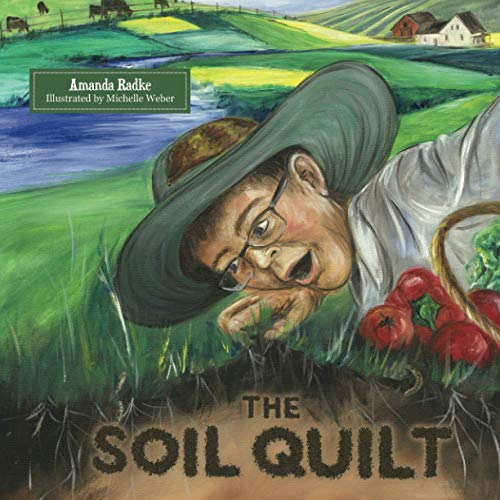
The Soil Quilt: America’s Healthy Soil – A Living Legacy for the Future
Author: Amanda Radke, Illustrations by Michelle Weber | Paperback, 59 pages
This story is presented from a very believable angle: a grandson visits his grandmother on her farm and learns about farming. As a non-farmer, there is plenty of opportunities for questions from the grandson. As he follows along with Grandma on her daily routine, conversation opens on topics such as organic matter in soil and the Great Dust Bowl of the 1930s.
Like many of the Amanda Radke books, they take a glimpse into everyday farm life. I give it extra points for making Grandma look cool (she operates a drone). Overall, the topic of regenerative agriculture is a small portion of the story. However, the glossary really shines, and becomes a great resource for covering the aspects of regenerative agriculture.

A Kid’s Guide to Regenerative Agriculture
Author: Lauren Lovejoy | Paperback, 76 pages (also available in hardcover)
I picked this book up, hoping to get some ideas for a field day for elementary school students. The book is divided into 12 chapters.
- Chapter 1: Regenerative Agriculture
- Chapter 2: Compost
- Chapter 3: No Till vs. Till
- Chapter 4: Cover Crops
- Chapter 5: Rotational Grazing
- Chapter 6: Planting Trees
- Chapter 7: Water
- Chapter 8: Seed Saving
- Chapter 9: Pollinators
- Chapter 10: Observing Your Environment
- Chapter 11: Biodiversity Index
- Chapter 12: Community Building
The lessons are structured with fun facts and hand’s on activities. Some of the activities take time, such as watching seeds grow. This could work well for home schooling, or in a traditional classroom, but not for a field day when you only get the kids for a limited time. FYI, these activities also are great resources for parents or grandparents. The book offers an opportunity to teach the younger generation about wise farm practices.
The only part that was missing was talking about the contributions of manure within the topic of rotational grazing. That, and the absence of the pesticide/herbicide/insecticide discussion.
Overall, this is a very comprehensive book about healthy farming practices. I appreciate the ready-to-go activities that have been well thought out. The book is a tremendous resource and a good springboard to inspire other ideas for activities.
Regenerative Farmers of America is promoted in this book. FYI, this website is under the ownership and direction of Lauren Lovejoy & Eric Conrad.